


What is a Presbyopic Implant
Status: Medical Testing
Corneal implant for the correction of presbyopia
For many people with good visual acuity, presbyopia, which begins between the ages of 40 and 45, presents a real challenge. Many cannot get used to reading glasses or progressive lenses. The aim of research and development is to develop a corneal implant that enables multifocal imaging of the cornea and thus a kind of multifocal cornea in order to avoid wearing reading glasses in these people by restoring near vision without loss of visual acuity in the distance. For this purpose, we have developed the world’s smallest corneal implant with a diameter of only approx. 100 micrometers, which can be inserted into the cornea in a minimally invasive, painless and reversible procedure lasting approx. 15 minutes. The first procedures on humans have already been carried out successfully. The next step is to conduct clinical studies to demonstrate the effectiveness and safety of the treatment on a larger collective. The implant is not transparent and, due to its small size, does not lead to any reduction, but rather to an improvement in visual acuity.
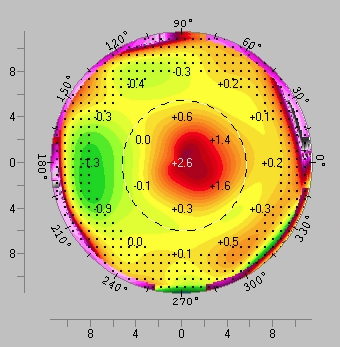
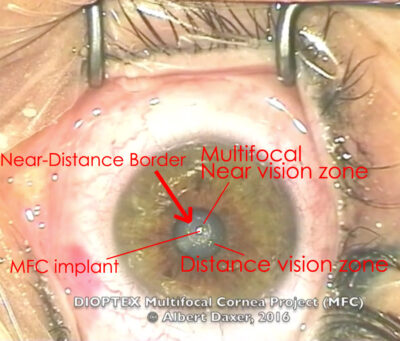
Pilot study: On the left, you can see the topographic difference between the pre- and postoperative state. A near addition of approx. 2.5 diopters in the cornea can clearly be detected. This near zone is surrounded by the far zone, with which one sees unchanged in the distance.